
A premium flexible office vs low cost space might look similar on paper, but the difference shows up the moment you walk in the door. The flexible office market has grown so much that today there’s an enormous range of options: from bare-bones budget spaces to premium centers with top-tier finishes and high-level services. Understanding the real difference between a premium vs low cost option is essential for making the right decision for your company. Because choosing a workspace isn’t just about price, it affects team productivity, brand image, and your ability to attract talent.
The First Difference: Physical Environment and Design
In a low-cost space, the priority is fitting as many desks as possible into the smallest footprint. This translates into high occupancy density, functional but ergonomically poor furniture, standard lighting, and little attention to acoustic comfort.
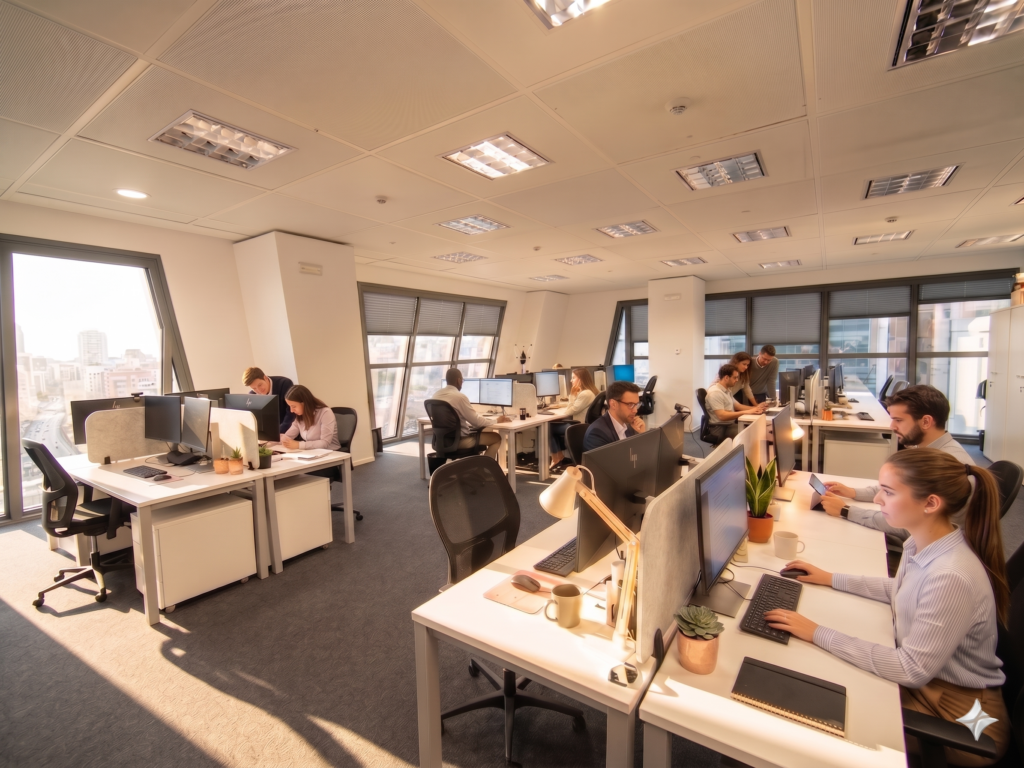
A premium space invests in interior design, quality materials, smart zoning (focus zones, collaboration areas, break-out spaces), and optimal environmental conditions: temperature, air quality, natural light, and controlled noise levels. This isn’t aesthetics for aesthetics’ sake; the physical environment has a proven impact on team productivity and wellbeing.
Connectivity: The Difference You Notice Every Single Day
Internet connectivity in a workspace is critical infrastructure. Low-cost spaces usually offer a basic shared connection, with no SLA (service level agreement) and no redundancy. During peak demand, speeds drop and video calls become unstable.
A premium operator guarantees high-speed symmetrical fiber, connection redundancy, and available technical support. For any company relying on cloud tools, video conferencing, or data transfers, this difference is far from minor. This is exactly the kind of gap that separates a premium flexible office vs low cost setup in daily use.
Included Services: What Looks Free Usually Isn’t
Low-cost spaces often have an attractive entry price, but many basic services are billed separately: printing, meeting room usage, coffee, lockers, visitor reception, or courier handling. Once you add up all these extras, the real cost can approach, or even exceed, that of a premium space that bundles everything into a single fee.
In a premium center, the “all-inclusive” model brings cost predictability and removes the friction of constantly managing micro-payments which is often the hidden cost gap between a premium flexible office vs low cost plan.
Reception and Front-Desk Service: Your Company’s First Impression
The reception experience is another area where a premium flexible office vs low cost space diverges immediately. When a client or candidate visits your office, the first person they interact with is the space’s reception team. In a low-cost environment, this role is often minimal or nonexistent. In a premium space, reception is staffed by trained professionals who welcome your visitors with the same quality you’d expect from your own team.
This detail might seem small, but it has a direct impact on how your company is perceived.
Location and Address: Not All Streets Carry the Same Weight
Low-cost spaces tend to sit in peripheral areas or second-tier buildings to keep rents down. A premium operator chooses strategic locations: established business corridors, strong public transport access, and an address that signals financial solidity.
At First Workplaces, our centers in Madrid, Barcelona, and Málaga are located in some of the best areas of each city precisely because we know your address is part of your company’s image. It’s one of the clearest ways a premium vs low cost alternative shows its value before you even step inside.
Certifications: What Sets a Premium Flexible Office vs Low Cost Space Apart
An objective indicator of a workspace’s quality is its certifications. Seals like BREEAM (building energy efficiency and sustainability), the Sello Spatium (workspace quality), or indoor air quality (IAQ) certifications confirm that a space meets objective standards, beyond marketing claims. Independent research has even linked BREEAM-certified buildings to measurable rental and sales premiums, which shows why serious operators pursue it.
Several of our centers hold BREEAM Excellent certification, the Sello Spatium, and IAQ certification, placing them among the most qualified workspaces in the Spanish market. According to The Instant Group, quality and design credentials like these are becoming a key differentiator as flexible workspace matures as an asset class.
When Does a Low-Cost Option Make Sense?
To be fair: a low-cost option can make sense in very specific situations — a one-off need for a single desk for a few days, an extremely tight pre-seed budget, or sporadic use with no client meetings involved. Outside of those cases, hidden costs, lost productivity, and the impact on brand image usually outweigh the initial savings.





Would you like to find out more about our coworking spaces?
Let us know what you need. We will provide the best information and services for your business. And if you prefer to visit us in person, please feel free – we look forward to meeting you!


